The Academy Blog

Tomorrow: Academy Orientation and First Day of Class

By Ian Factor (MFA 2014)

My arrival in NYC about a week ago was interesting to say the least…when I finally found the apartment I had rented and went to open the door with the keys I had been given, none of them worked…locked out with a full bladder, double parked with a full truck. Good start, but the positive news was that my truck made it in one piece.

About 2 hours later and 3 generations of family members coming to let the “new tenant” in, they finally got the key thing straightened out, and I entered. I unloaded (the truck and my bladder) and at 10pm got in the Q-train and headed for Manhattan.


I stayed with a good friend who has a gorgeous apartment just behind the World Trade Center with great private rooftop terrace overlooking the Hudson River and NJ. 

Sunset Sails over the Hudson River from Battery Park Terrace


Sunset view over the Hudson River from Battery Park Terrace

For a few days while I searched for a bed and some basic furnishings my host of hosts allowed me to stay in his extra bedroom overlooking Battery Park City and the Promenade there. 

Here’s a quick sketch from day one:

Quick sketch from Battery Park Promenade. Statue Of Liberty in Background

Here’s a good, and disturbing story; On my LAST visit to the Sleazy’s (I mean. Sleepy’s) while I was getting the heavy handed bait-and-switch, I literally saw a bedbug crawling over the top of one of the “New” mattresses! (FYI, this was at the Sleepy’s in Sheapshead Brooklyn). I naturally and immediately pointed it out to the salesman and he quickly slapped the mattress next to the bug as it went flying into the air to land most likely on another unsuspecting sample bed. His slick and frighteningly nonchalant comment was, “It’s not like it’s the first time I’ve seen that…”The difficulty in finding a bed in the city, without getting ripped off or having to drive out to some suburb of New Jersey, was profound. I was still exhausted from packing up everything in Boston and moving here, and the fatigue continued while I drove around from one end of Brooklyn to the other and took the train in and out of Manhattan, dealing with the sleaziest of sleazy bed salesmen at more than one “Sleepy’s” (Dont EVER shop there!!)

I left without saying a word. True story.


Onto IKEA, the weekend of Labor Day, probably the busiest bed and furniture shopping day of the year for students and proud (and exhausted) parents of new students heading off to school.


Chaos doesn’t describe the scene at the Brooklyn Store, the lines at checkout reminding me of my first visit to Disney World as an 8 year old…minus the rides and Mickey Mouse. IKEA Brooklyn, which is the main warehouse, the size of most large city’s airports, is daunting and overwhelming, regardless of the packs of frantic shoppers. 


Needless to say, I could write a novel about the few days spent there. 


Instead, here’s a sketch of a sleeping man on the Q-Train that sums up how the shopping left me feeling:

Man Sleeping on Q-Train – Brooklyn


Finally, as of two days ago I have a new bed. 

So today, Sunday I woke early, rode my bike down to Manhattan Beach, about a 7 minute ride from my apartment, just on the other side of Sheapshead Bay, and then rode over to Brighton Beach and down the length of the Coney Island Boardwalk, along the beach to the far end, actually the end closer to NYC. It was my first time there, Coney Island…
like another country. It was a beautiful, perfect sunny day with large gorgeous cumulus   and cumulonimbus clouds after yesterday’s double tornado touching down in Brooklyn and Queens. The language I most commonly heard was Russian, with a smattering of Spanish and a few random English words thrown in. There’s a huge Russian population here in this part of Brooklyn, a language I love to hear and not understand. Just the sound and intonation is intriguing. 


Here are a couple shots of the first riders of the day at Coney Island:

Coney Island – First Ride Of The Day


Coney Island – Wonder Wheel and The Strange Evil Cat Ride


And then on my way home I stopped here at Brighton Beach to take this one more shot:

Brighton Beach – Under The ‘Stares’


Now sitting in Starbucks, for the free internet and not-so-free cup of tea, I enter this Blog…and watch the middle school kids violently threaten the other middle school kids. Maybe we should be giving them Vodka to drink at that age instead of Coffee drinks.

Orientation at the Academy is tomorrow, studio move in is 8:30am. 
Time for a good meal and a good night sleep. 

Much more soon…

Ian
 

Ian Factor (MFA 2014) will be blogging here throughout the year about his first year at the Academy and moving to New York City.  You can also follow more of Ian’s experiences on his blog: Ian Factor’s New York Academy of Art Experience.

POST NATURAL: 2012 FELLOWS EXHIBITION

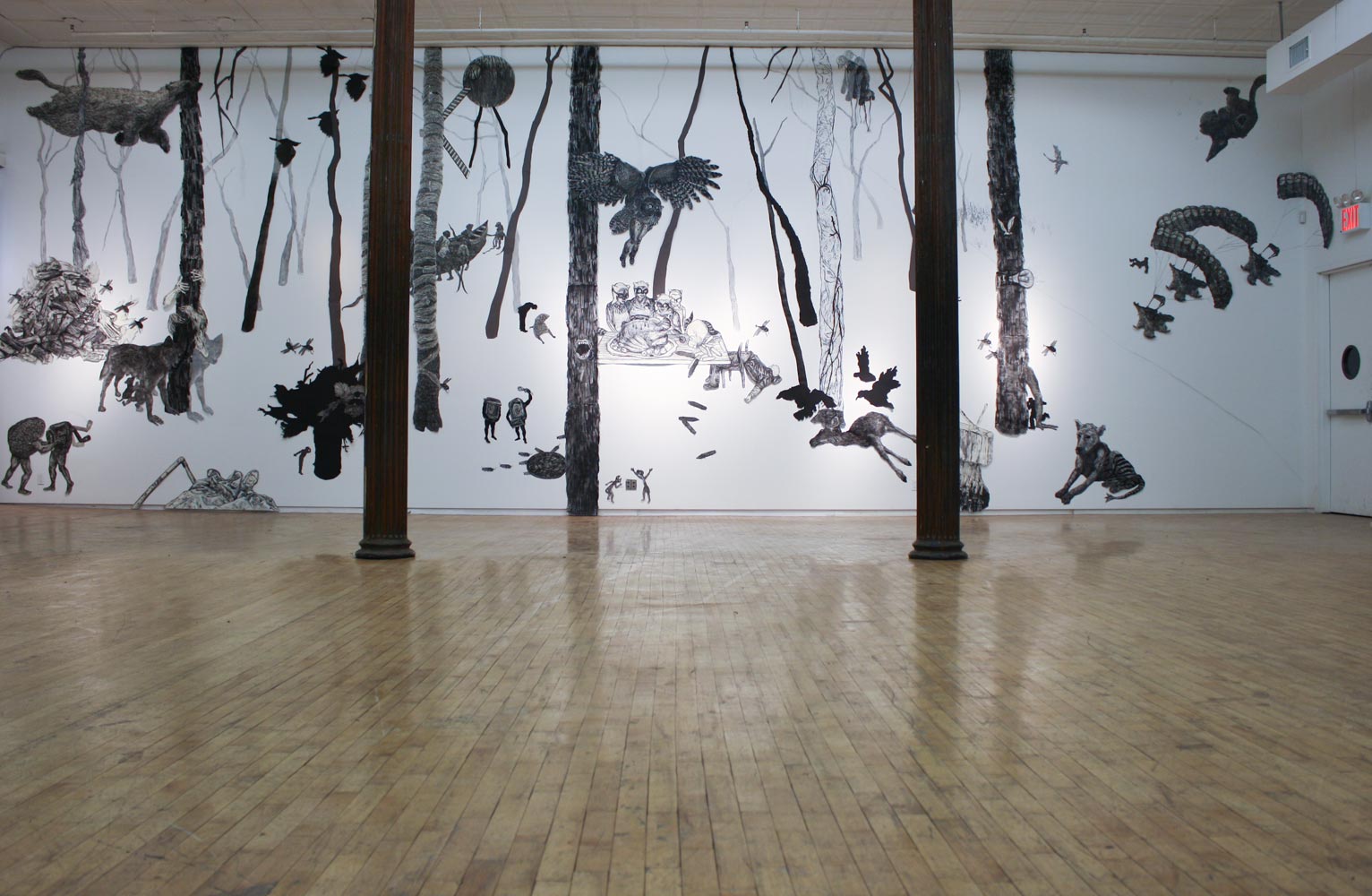
An exhibition of the 2012 Fellows of the New York Academy of Art: Emily Davis Adams (MFA 2011, Fellow 2012) , Ian Healy (MFA 2011, Fellow 2012) and Aliene De Souza Howell (MFA 2011, Fellow 2012).
 

Carrara: The Impossible Dream

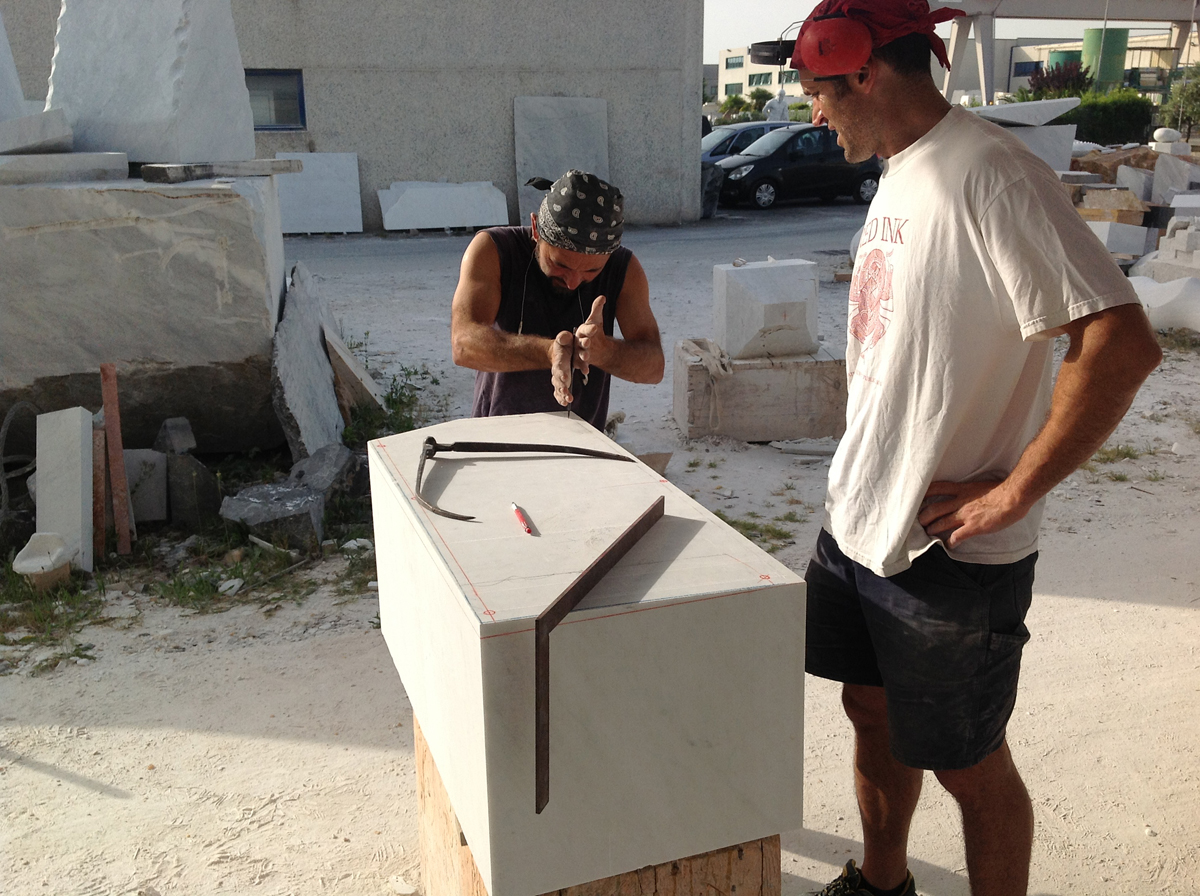
June 18 – July 3, 2012, recent Academy graduate Joseph Brickey (MFA 2012) lived and worked in Carrara, Italy as part of a two-week Artist in Residence Program coordinated by ABC Stone and The Oriano Galloni Foundation.

By way of introduction, I’ve always felt I could do anything an artist aught to be able to do.  Can I draw? Sure. Give me a pencil, and I can move it in any direction. What about paint? Oh, you mean that soft, creamy stuff that comes in nice little tubes? Sure. I even know where to get special brushes so you can rub it around without getting any on your fingers. Can I sculpt? Well, I grew up playing in the mud. That’s a material I understand.
But what about stone carving, you ask? What?? Did you say stone?? You mean that material that shooting stars are made of, that sinks ships, divides the oceans, forms mountains, turns aside rivers, crushes whatever stands between it and the center of the earth?  This is the material upon which all the world stands for support. A wise man might build upon it, but what fool would try to carve it?  Even Mother Nature herself only carves by the minuscule per millennium.
That’s right, I know about stone. I’ve had my own experiences with it. I’ve climbed it, kicked it, smacked it, and stubbed my toes on it. Throughout my entire life, anytime I’ve come up against stone, it always wins. It’s just instinctive now: when we cross paths, stone always has the right of way. It’s simple, really. I’m made from the dust, the stuff smashed between the rocks, the stuff that is washed away by the wind and the rain, while the stone, well, it isn’t. 
So if you ask me about stone carving, I’m thinking you must mean the stone doing the carving on me.  What then? Into a stone box I go, unto the dust I return, six feet under a stone marker that warns the world: “This man thought stone carving was a good idea.”
So that’s where I’m coming from. At least until the opportunity came to go to Carrara.
Hence it shouldn’t seem so strange that stone carving–most certainly humanity’s first dip into the arts–feels to me more like my final frontier as an artist.  But unwittingly my creative impulse had always been carrying me closer. All along it was a natural fit for my artistic identity, the eventuality of all of my efforts and interests. But aspiration cannot live without expectation, and marble carving was on the same list as cloud surfing and comet riding. 
I had thought that turning to sculpture a couple of years ago completed my ambitions. I had used drawing materials, painting materials, and now sculpting materials. But marble was an entirely different thing. In the court of the great masters, I had tried out every seat in the house, but I had never considered actually taking the throne. Not that I don’t think big. I’m a guy who has considered planting a garden on Mount Everest, camping on the dark side of the moon, crab walking to the edge of the earth, and then rappelling down. But carving a marble sculpture?! It seemed so far fetched, so foreign, so unfathomable, that even to man prone to ambition, it remained the impossible dream.
Then came the generosity of Jonathon Tibett of ABC Stone, the groundwork of SteveShaheen (MFA 2005), and the great resource that is the New York Academy of Art. When the news came that I had received the marble carving residency, I was suddenly cloud hugging and comet kissing. Mount Everest could melt, the edge of the earth could go drop off itself—I was going to Carrara!!!
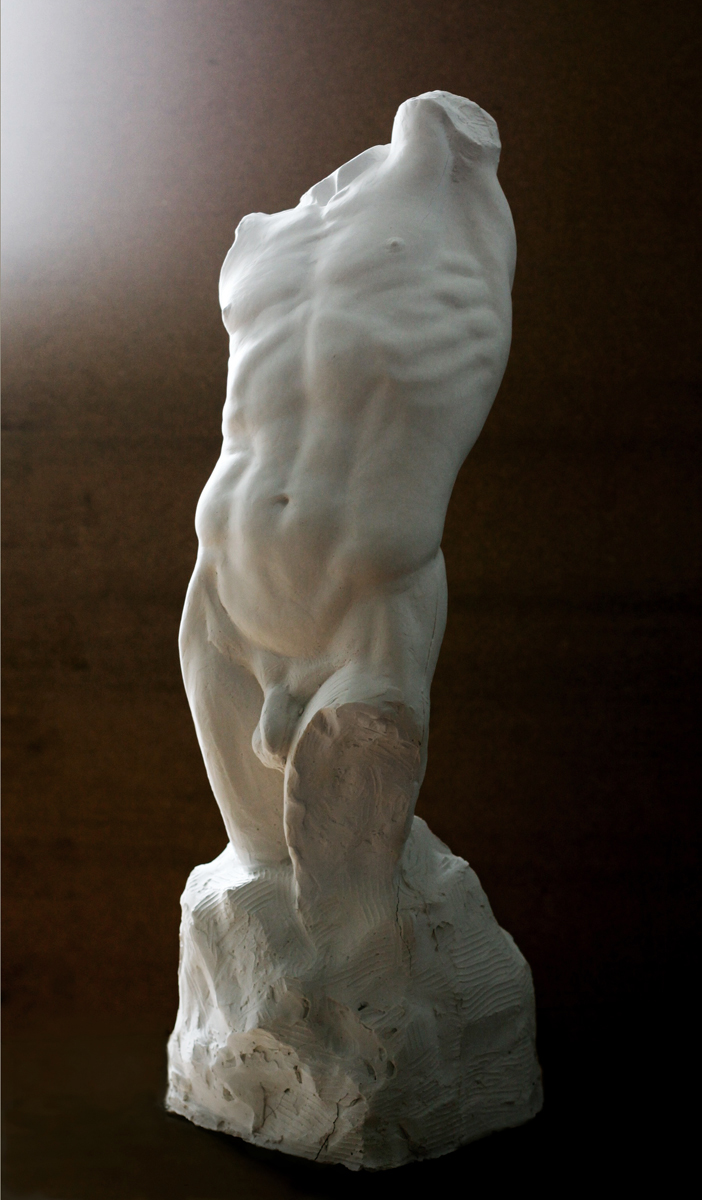
Part of my preparation was to decide on a subject and create a model to work from while there. I felt I should do something that would test me with the technique, something with nuance and detail, subtle shifts in form, demanding precise proportion and surface treatment. In short, something that would be a good test for future carving possibilities, for I felt that if the honeymoon went well, so would the marriage.
Michelangelos Maquette
There was no doubt that I wanted to do something figurative, but with forms conceived for the material of stone. This was new for me and my mind immediately sought answers from the great Michelangelo. I looked not only to his final sculptures but also to those sketches and preliminary works that demonstrated earlier conceptual phases.  Among his surviving works that were preparatory for his marble sculptures is a terra cotta maquette of a male torso done for his Awakening Slave.
  
Pen & Ink of Male Torso

Toned Drawing of Male Torso
This point of reference seemed to fit my native impulse, and as I began to work out my own interpretation, I felt a sort of dialogue develop, consulting the great master at every turn (and occasionally bickering with his counsel). It became a process where I either had to justify my own path or come to understand the reason for his. In the end, whether my model was a tribute or an insult to his wisdom, I’d made my case and was ready to stand by it.


Model of Male Torso
Now I simply had to go to Italy to make the same argument to some block of marble… and I was unbelievably excited!!!


Check back here for more of Joseph’s reflections on his residency and first experience working with stone.

Our Giverny Hamlet

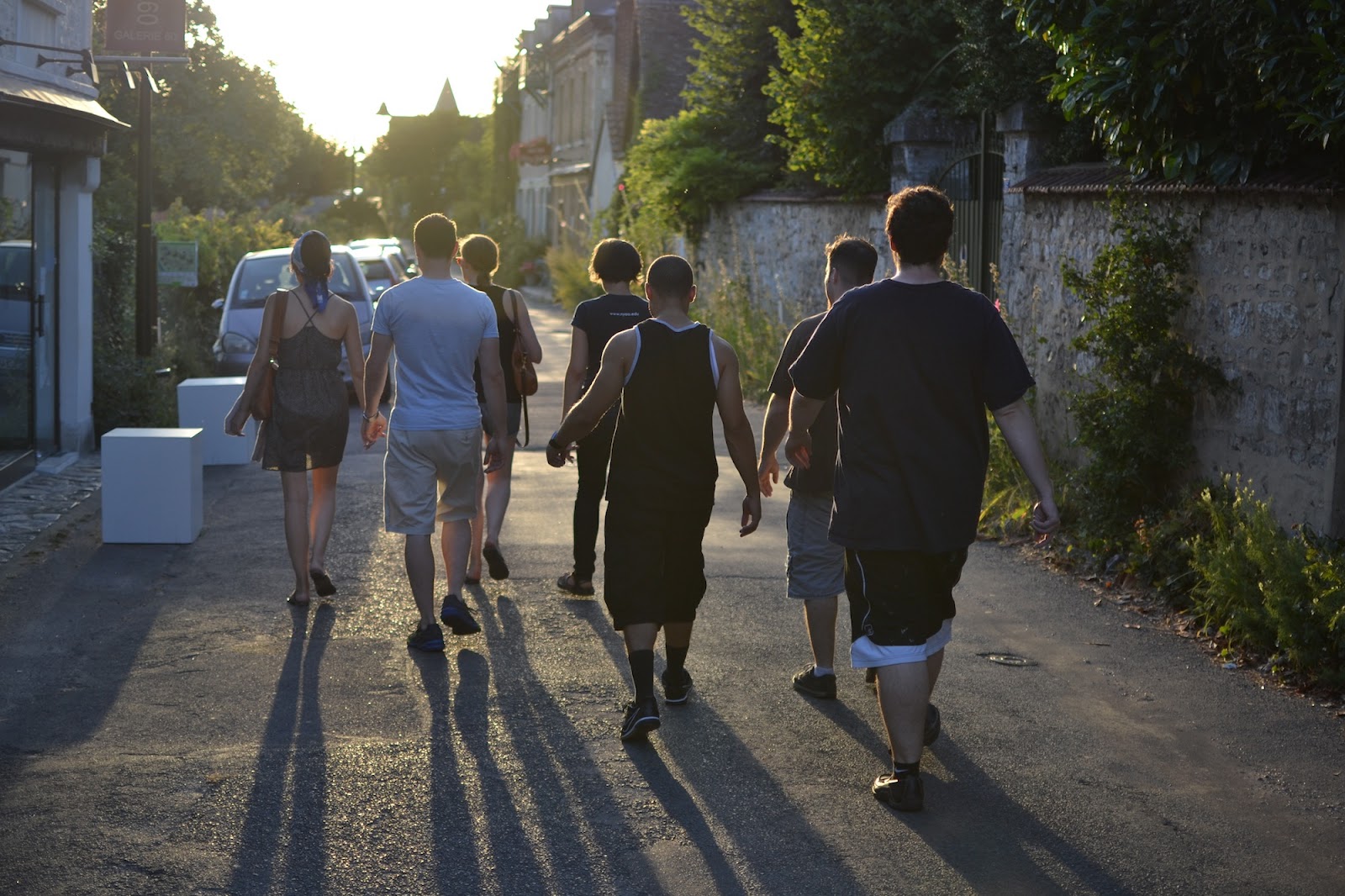
August 13-26, eight Academy students lived and worked at the Terra Foundation for American Art-Europe in Giverny, France as part of a two-week Artist in Residence Program.  Daniel Bilodeau (MFA 2013), Adam Carnes (MFA 2013), Ivy Hickam (MFA 2013), Jacob Hicks (MFA 2012), Gaetanne Lavoie (MFA 2013), Robert Plater (MFA 2013), Amanda Scuglia (MFA 2013) and Valentina Stanislavskaia (MFA 2013) will continue to share their experiences here.


Tuesday, August 14:

Today I rode up a hill with a borrowed mountain bike to the edge of a farm field.  I could see little houses and valleys below.  On my way I met two horses, one black, one white. Irritated by flies in their eyes they kept nodding their heads at me.  I patted their warm brows.  A young French girl, who must have stepped out of a painting, walked over to me calling out the horses’ names.  She was rosy cheeked and wore a dress the color of the sky.  I spoke to her in my broken French and she patiently waited to understand.  When I said “Je suis Américain,” she smiled.  She lives in a house down the way.  I wished I could paint her.  I said “À tout à l’heure” and hopped back on my bike.
An attempt at a landscape was made farther on up the hill.  A sweaty brow and spilt water decided when it 
was done. I had fussed with it too much and the lights were muddied.  But with renewed excitement for watercolor and landscape, I decided I would try again the next day for I’m out of practice in plein air and I knew that’s how the day’s painting would go.


After first week’s crit, leaving Le Hameau

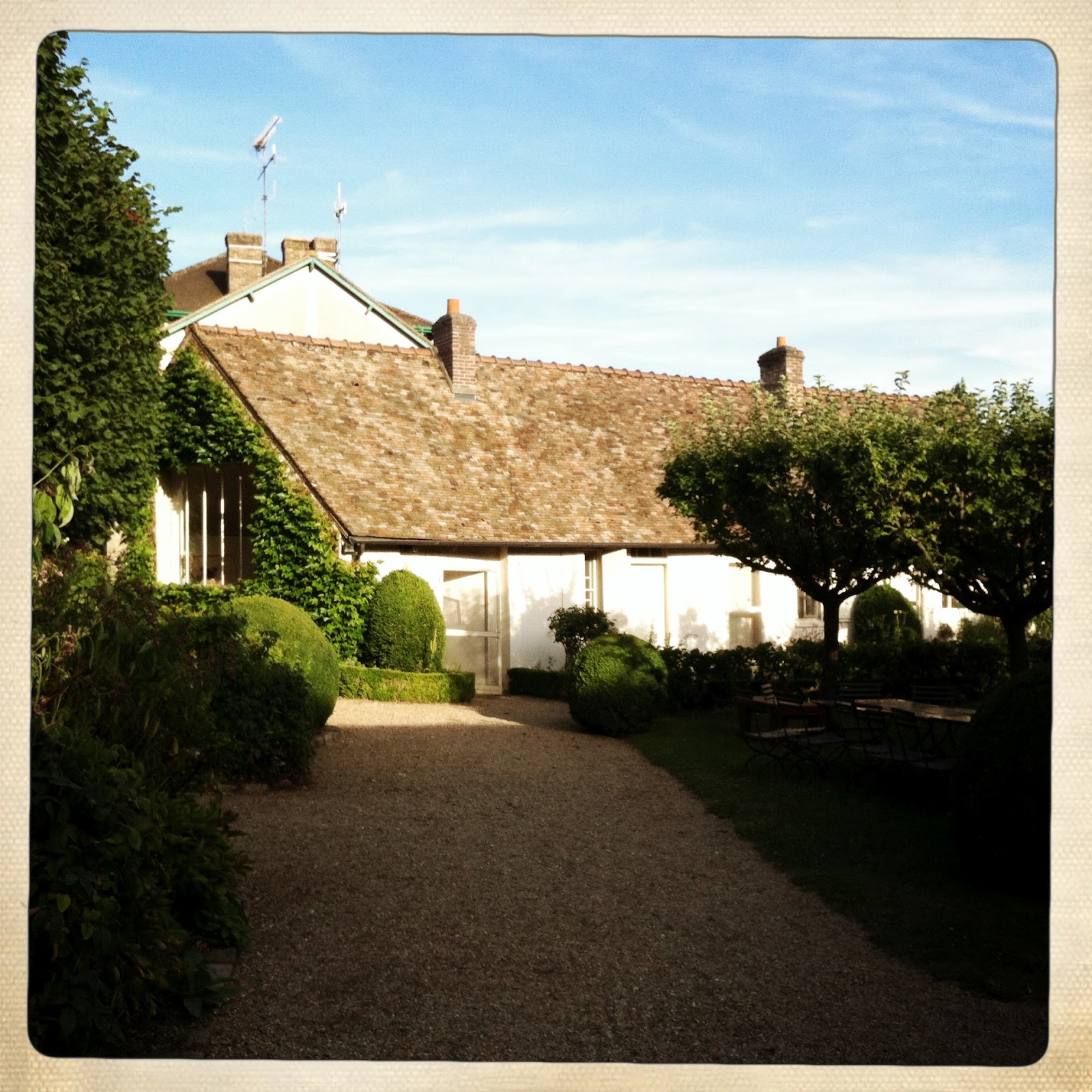
The studio area the Terra Foundation gave us for the two weeks is called “Le Hameau.” The studios are said to have a lot of soul.  They are rich in history; Lilla Cabot Perry, Frederick Carl Frieseke, Mary Wheeler, and Richard Miller all painted here.

“Lady in a garden,” Frederick Carl Frieseke


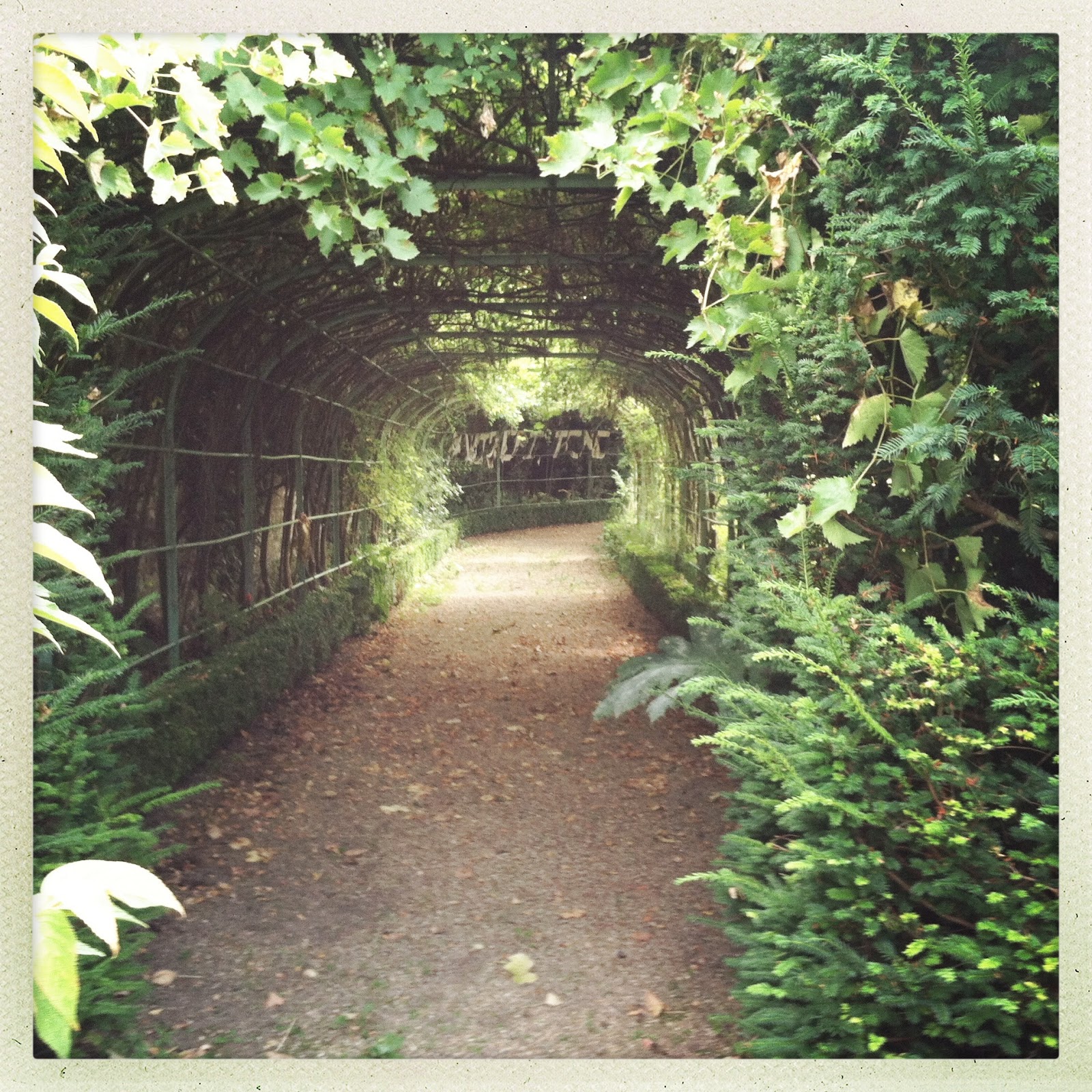
The interior of my studio is always cool inside because of its thick walls.  It has an old fireplace and touches of paint from previous residents. I’ve contributed gesso marks to the floor and a large branch from a berry bush cut and left by the gardener.  The gardens hiding to the right of the building are a little wild; not too perfectly kept and lovingly overgrown. 


The Wonder of Giverny


by Amanda Scuglia, MFA 2013

Last semester I was selected to participate in an artist residency at the Terra Foundation for American Art Europe in France! The New York Academy nominated eight students and one professor to travel to Giverny for this incredible opportunity. Jean-Pierre Roy, Jacobs Hicks, Ivy Hickam, Robert Plater, Daniel Bilodeau, Valentina Stanislavskaia, Gaetanne Lavoie, Adam Carnes and I arrived in Paris a week early to do some research. We visited the Louvre, the Centre Pompidou, the Musee D’Orsay and a few contemporary art galleries. We also fit in some tourist stuff- like picnics at the Eiffel Tower, shopping at the Sennelier store, waiting in line and eventually getting to see the catacombs, partying at the Sacre Coeur, flea marketing, etc. After all that inspiration, we knew it was time to get to work.


When we all arrived in Giverny, we were greeted by our guide Miranda. She was extremely knowledgable with an absolutely delightful personality. Immediately the group was very taken with the place. We all arrived feeling very, very grateful.

The town, with less than 500 residents, was full of charm and covered in flowers. We had extremely comfortable living situations as well as generously sized studios (equipped with an apple orchard!). A chef prepared our dinner and dessert and delivered it daily. We all met for lunch everyday, which was provided by the Impressionist Museum cafe. When we weren’t in the studio working, we were taking day trips to new landscapes, exploring surrounding towns by bike, or plein-air painting.


One of the coolest experiences from Giverny was Monet’s house and gardens. It was gorgeous, but crowds of tourists filled it everyday. As a courtesy, they closed it to the public one evening, and allowed us entry so that we could paint peacefully.


We formed friendships and bonds that otherwise might not have happened. We learned so much about each other’s work as well as our own. And we got to see how this place had changed our work. It’s a short period of time that none of us will forget. I cannot thank the Academy and the Terra Foundation enough for the opportunity.


Impression, Soleil Levant

August 13-26, eight Academy students lived and worked at the Terra Foundation for American Art-Europe in Giverny, France as part of a two-week Artist in Residence Program.  Daniel Bilodeau (MFA 2013), Adam Carnes (MFA 2013), Ivy Hickam (MFA 2013), Jacob Hicks (MFA 2012), Gaetanne Lavoie (MFA 2013), Robert Plater (MFA 2013), Amanda Scuglia (MFA 2013) and Valentina Stanislavskaia (MFA 2013) will continue to share their experiences here.


Over the course of two weeks I was lucky enough to join a group of gifted artists led by Professor Jean-Pierre Roy, Daniel Bilodeau (MFA 2013), Adam Carnes (MFA 2013), Ivy Hickam (MFA 2013), Jacob Hicks (MFA 2012), Gaetanne Lavoie (MFA 2013), Robert Plater (MFA 2013), Amanda Scuglia (MFA 2013) and Valentina Stanislavskaia (MFA 2013), on a residency in Giverny, France, the residence of revolutionary seer, Claude Monet.  
Monet was wholly indebted to phenomenological truth, more than he was indebted to pre-conceived standards of art affixed to institutionalization.  He was never to give himself over to the ways in which he was taught to see-though he was clearly taught, from an early age, the precedence of French academic art.  History is opened when placed in the hands of someone willing first to learn, and then to seek change.   
Initially to him, I assume, it must have seemed ludicrous to speak the visual language of established artistic tradition and call it mimetic truth– as it seems ludicrous for any member of contemporary life to refer to a Cimabue painting as the realistic mirror of the human eye to the exterior world. 
Traditions are born.  They swell, grow roots, share excitements, age, and then must be upended, just as the dilapidated building, whose structure was once perfect, must be demolished and rebuilt.  To upend institutional thought is to teach us our thoughts want and will always focus on progression.  We are taught ideas as if they are unchangeable, but to triumph is to change.
So Monet goes outside, to a garden, and decides to paint the arc of time by way of color and movement.  He dabs in the changing light against a white linen the optical equivalencies of water, weeping willow, chapel, haystack, human–knowing those containing lines of structure are the lies of his mind wanting to create demarcations and separations.  What he comprehends is the melt of visual unity.
He calls a work Impressionist Sunrise, and his critics poke fun and name his friends and followers “Impressionists.”   The sonorous bell of the word rings, and the way western society sees again moves.  A new cathedral of thought slowly builds awaiting its fall.
It is necessary to love the modes of thought that shape us, that come before, and to thank them.  It is our duty to shape new modes of thought.

A Place of Beauty

On August 13, eight Academy students arrived at the Terra Foundation for American Art-Europe in Giverny, France to begin a two-week Artist in Residence Program.  Daniel Bilodeau (MFA 2013), Adam Carnes (MFA 2013), Ivy Hickam (MFA 2013), Jacob Hicks (MFA 2012), Gaetanne Lavoie (MFA 2013), Robert Plater (MFA 2013), Amanda Scuglia (MFA 2013) and Valentina Stanislavskaia (MFA 2013) will share their experiences here throughout their residency.
Giverny is a place of beauty. Replete with trees and flowers, filled with fresh air, the lifestyle in this small French village is at once both simple and sophisticated.
On the day of our arrival we were met at the train station in the neighboring town of Vernon by Miranda, our hostess and facilitator. Taking us into Giverny, she introduced us to the area and took us on a tour of the grounds. We chose rooms to live in, studios to work in, and bicycles with which to explore. Miranda has been truly kind and helpful to us. As a group we walked, visited Monet’s outdoor grave, and ate our first residency meals.
Monet’s gravesite
When I woke up yesterday I just lay there for a while listening to the birds sing. Eventually, there came the charming and unexpected bbbaaaaaa sound of a sheep bleating. It is kept nearby with emu and ostriches. We began the day with a trip to the Impressionist Museum right here in town. We had a nice guide who had a strong accent and a good command of English, but had probably never addressed a group of people for a long time in the language before. Her voice would begin to shake with nervousness, and we would seek to ease her with approving looks of interest and comprehension. The collection was great and unexpected. Afterwards, we moved our bicycles then went into Vernon by van to satisfy outstanding needs for supplies and personal snacks and wine. We had a lot of fun with french words, the radio, and potato chips in unfamiliar flavors such as roast chicken with thyme, cheeseburger and kebab. 
Today we went to Monet’s house and garden first thing. Monet’s extensive collection of Japanese woodblock prints was superb, and the garden beautiful. Best for sure is the large lily pond surrounded by so many beautiful trees and flowers; featuring two little bridges. I remained in this area for a long time, as it grew more enchanting as I stayed longer. I made two little drawings. As tourists passed me, they commented in a variety of the world’s languages and about fifteen different parties took my picture, which was funny.
We are well taken care of here. The food has been excellent. In the morning there are various breads and cheeses and jams and fruit and of course, Nutella. For lunch we all meet at 12:30 in the museum cafeteria where we have a variety of fresh options including a new plat du jour and desert du jour each day. Chicken, pork, fish,french sauces, big salads. It is delicious fare, and comes with beer or wine or orangina, etc. and a desert from a long list of temptations including chocolate lava cake and numerous flavors of amazing ice cream. Add to it espresso or cafe creme, and it is a satisfying but lengthy operation; taking nearly two hours each day. The dinner is equally good, delivered by a chef to our fridge and only requiring that we set the table and heat it up in the oven. 
Everything in this picturesque village is very attractive, well attended by tourists, and well kept. I’m looking forward to biking around and exploring the natural outskirts some more. My studio space has an old European personality and opens into a beautifully manicured group of apple trees. I share it with Jacob, and we will be spending a lot of time in there. 
There is a great sense of appreciation amongst the group, and we all look forward to the nourishment, creation, and building of fond memories promised by an experience such as this.

Summer of Prisms

June 1 – July 31, 2012, four Academy students lived and worked in Liepzig, Germany as artists on an 8-week Artist in Residence Program.  Brian Dang (MFA 2013), Robert Fundis (MFA 2013), Elizabeth Glaessner (MFA 2013) and Noelle Timmons (MFA 2013) have continued to share their experiences here.


By Noelle Timmons (MFA 2013)

As all humans experience their lives through the bubble of their own environment, we as artists, and especially students, also get to see our artwork through the said bubble. So, luckily for us, and all other thinkers and creatives, we basically get double-bubble-exposure—we create work that exists within our environment and we process it in a way that is conducive and representative of it. Of course this is nothing new. But, when you are so completely cut-off from your bubble, for the first time, in regard to your art-making practice, when you’ve been dropped from outer space and find yourself in the most East-of-East-Germany-Leipzig, with absolutely nothing familiar around, your bubble is understandably popped. And now it’s been replaced with something different: a prism.


The prism is Leipzig, it’s the Spinnerei, and our entire abroad experience. It’s not as constricting and suffocating as the bubble; it’s multifaceted for more variety and interpretation. But, the prism makes everything seem crazy, kind of Twilight Zone. So I began to see the art world differently, to see some of my favorite artists differently, and of course, to see everything I painted, drew, and scribbled differently. It took time to see my work through this prism. It especially took time to figure out which version, which plane of the prism, I wanted my art to sync with, if any. But the most monumentally difficult thing was to become so comfortable with the new-ness and large-ness of the prism, that I saw myself, and my artwork, in spite of it all. To not get overwhelmed, to not loose sight of my core intuition and creative drive (to not runaway with the German circus), that was the real challenge of the brilliant Leipzig prism.


And so we were free to experiment, to make things we never would or “could” make in New York. We received insight from fellow residents and artists, insight so new and fresh, and sometimes severe, that we were again faced with the warped prism. This residency was enchanting, confusing, and at times, downright maddening (communal living was, ahem, new, for all of us). But I feel lighter, more free, inspired, and confident in my art practice than I ever have. I don’t think I shattered the prism; I still imagine it and let myself sit uncomfortably in it for a moment. But there was a moment in late June, and another in late July, when I just seamlessly wandered out, found myself painting, and knew I had gotten what I needed from Leipzig, from the residency, from the prism of our new space and environment. 


Inside The Studio With Aleah Chapin (MFA 2012, Fellow 2013)

By Maria Teicher, MFA 2013

Even though Aleah and I are in the same age bracket, going to the same school and she is someone I would consider a friend or confidant, I was nervous to interview her. Risking sounding strange, I admit that I’m a big fan. Her work has always exuded this pure sincerity and it is something I am continually striving for myself. Only one year ahead of me at the New York Academy of Art, I look up to her, her work ethic and ability to stay who she is (while continuing to discover who she’s becoming) in an ever-changing art world.

I photographed Aleah in her studio about a month before she graduated this May. She had just been accepted as one of the four finalists in the 2012 BP Portrait Awards. An exciting time for her for sure and the entire school was also buzzing with joy. We met up early in the morning and began talking about her recent success. Albeit filled with excitement, she was calm and rather serene, simply happy to have been a finalist and gotten that far. I can exclaim now, that just a few months ago, Aleah has been named the winner of this year’s BP Portrait award. With it comes the prestigious first prize of £25,000 and a commission worth £4,000. This is an incredible achievement for anyone and certainly for someone only 26 years of age, graduating from getting her masters just a month before. In case you haven’t heard, Aleah is also staying aboard at NYAA, as she has been awarded one of three fellowships. We’re pretty excited that we get to keep her for another year and I am certainly thrilled to be able to watch her work and learn from her for another two semesters.

With all the great accomplishments surrounding Aleah this summer, she found some time to answer a few of my questions about her life, her work and what’s been happening.

Aleah grew up on an island north of Seattle about as far west on this continent as possible. She had to make a quick adjustment to NY, moving in just four days prior to starting her first semester, but feels like she’s really discovering a new city now, two years later. ” I’ve spent the majority of the last two years at my studio at NYAA, so now that I’m graduated, its like adjusting to a whole new city, one that I have only seen bits and pieces of.” She’s recently settled into a studio in the Bushwick area of Brooklyn in a building that is full of artists, many figurative. “It feels good to burrow myself into a new part of this city, but I am really looking forward to coming back to the Academy in the fall for the Fellowship!”

Maria: “What does your artistic background look like?”
Aleah: “My artistic background is quite varied. I’ve been extremely lucky to have parents who are very supportive (and artists themselves). Throughout high school, I would go one evening a week to the studio of a local artist named Pete Jordan. By 18, I knew I didn’t want to stop painting. I attending Cornish College of the Arts in Seattle, WA and received a degree in painting and video. This school was fantastic in opening up my eyes to where I could take art and what I could do with it. Throughout college, I took several one week painting workshops at Gage Academy. I also did a study abroad at the Glasgow School of Art in Scotland. In my year between college and NYAA, I attended an intensive 2 month drawing program in Paris at a small and wonderful school called Studio Escalier. “


M: “Why have you chosen to pursue becoming a fine artist?”
A: “Besides a few rocky years in high school, I have known I wanted to be an artist. I remember drawing a tree when I was about 4 years old, and thinking “this feels good”. So, maybe thats how it all started? Or going to my mom’s studio early in the morning and watching her paint when I was so young I can barely remember. “

When I asked Aleah what drew her to the academy she tells me that the moment she saw the website, “It felt like home. I had to go.” “It was like if someone said ‘dream of your ideal school’ and voila, here it is. I couldn’t quite believe there was an MFA program that was focused on painting, drawing and sculpting the human body,” she says. Now, about three years later, one of Aleah’s paintings is on the first page of the academy’s site. One can only imagine that her work is now inspiring others to feel the same way and send their applications in.


M: “How would you describe your first year at the academy? Your 2nd year?
What’s the most valuable thing your learned?”
A: “My time at NYAA was the most exhausting, invigorating and inspiring two years of my life. I didn’t know I could work this hard, or paint this many hours a day, this many days a week. The first year is heavy with assignments, which I suppose could have been frustrating, but honestly, each one, no matter how simple, I felt that I could put my own artistic vision to and get something out of. It was a challenge, but a very rewarding one. I came into my first day of school thinking I knew exactly the kind of work I wanted to do. It was sometime in the first few weeks that I realized I had to let go of my “plan” if I wanted to grow and become a better artist. It wasn’t until the spring when I felt like I was perhaps finding something. The summer between first and second year, after a lot of confusion, I realized that what I was finding was myself – confidence and acceptance in the kind of person I am and of work I want to make.”

Aleah accredits the community at NYAA as being one of the most vital aspects of her two years studying. She considers them something beyond peers and more like family. “I think they are just as important in my education and development of my work as the teachers have been.” I have to agree with her there. The academy is a place where you really learn from everyone, most importantly those around you. Having open studios within the school during the semesters allows you to keep a consistent flow of energy around you at all times. From personal experience I can tell you that breaks from painting, drawing and sculpting include walking around your peer’s studios, discussing projects, pieces, the art world at large and grabbing coffee with those available. It’s an inspiring place to be at all times, as you’re growing and learning every minute you spend there. I can personally credit Aleah to encouraging me to take attend a dissection class at the end of my first semester. It was one of the highlights of my NYAA career thus far, and if I hadn’t felt like I was part of this little family, I never would’ve asked her advice about it.


M: “What are you planning for your year as a fellow?”
A: “I am really excited about this coming year as a Fellow. I don’t know exactly what the work will look like, but something that I learned over the past two years is to trust that the most honest work comes from being okay with not having a plan and being led by personal inspiration and intuition. What I do know is that it will be an extension of my thesis, the Aunties Project. I think that an artist’s best works comes from being honest with who they are, making work about what they know, which can only come from the life that you have lived.”


M: “Name some of your favorite painters.”
A: “Some of my favorite artists are Jenny Saville, Ron Mueck, Lucian Freud, Rembrandt, Velasquez. “

She goes a bit further to tell me some of the experiences she’s had with those that inspire her.

“I remember walking into the National Gallery in London when I was 16 and seeing a hyper real sculpture of a women laying on her back, her belly sagging slightly beneath the weight of her newborn child. This was Ron Mueck, and that show has stuck with me for the last 10 years.
In my first drawing class at Cornish College of the Arts, my teacher showed us a book of incredible figure paintings. They were simple; unidealized figures lounging on beds, their pale flesh painted in big, gooey, confident brush strokes. Of course I completely forgot the name of this artist and spent the next 6 months running into every book store I saw and frantically browsing the art section. Finally I found the book: Lucian Freud. Of course, I haven’t forgotten his name since then. “


M: “Is there anything you keep in your studio for luck or inspiration?”
A: “For the 4 years I studied with Pete Jordan in high school, I had a piece of cardboard which I would put all my paints on. This increasingly got smothered in paint and became something I had to always have in my studio. I think I still have this bit of cardboard somewhere. And then there is my apron. It was my moms before it became mine 10 years ago, and was covered in paint then. I have finally retired it (but not thrown it away!) because it has become so stiff with layers of paint that I’ve been told that much heavy metal on my body could be dangerous…but I am very attached to it. “


M: “Where does your drive to create come from?”
A: “My inspiration comes from different places. One is just that I love paint. I am a bit obsessed with it. And risking sounding cheesy, I believe it has magic. It can be extremely frustrating at times, mushing around in all the wrong ways, but when its working, the whole world disappears, and its just me and the canvas. Oil paint’s ability to not only re-present flesh, but become flesh, is one of the reasons I love to paint people. But I think I also paint people to better understand them. “

Going to Aleah’s studio for the first time, it was evident immediately that she just loved paint. It was most certainly everywhere, including layers on her computer. When I first walked in to take a few photos, she made the joke that her laptop was actually her thesis work and the rest was really nothing. Although I have never actually seen the cardboard piece she keeps or her mother’s old apron, previously mentioned, I can imagine they look similar and it gives some wonderful “behind-the-scenes” about how often Aleah paints and how much she simply loves the material she uses. Her dedication to painting shows within the walls of her studio, beyond the finished pieces that most only get to see on white gallery walls.


M: “How important is your studio space to your creative practice?”
A: “The most important part of my studio practice is dedication, and perhaps a good cup of coffee. Going into the studio every day, even if I don’t feel the slightest bit of inspiration, is extremely important. Treating it like a job but not in the negative sense. When it’s your job, you give it a certain amount of priority in your life, it gains that extra importance and becomes routine. For me, this routine gives me the freedom to feel inspired and excited. And when I’m not at “work” I’m able to relax. This last part is harder, and something I’m trying to work on. But I have found that having a schedule of some kind gives me the permission to enjoy life a bit which is vital for creating work. “


M: “Do you work on several projects at a time or just one? How long does a piece take you to complete?”
A: “I generally work on a few paintings at a time. I never used to do this, but since my painting days have become longer, I have found that having a few projects going on at once helps a lot. My paintings vary in size quite a lot, and so does the time working on them. The smallest take about a week, the largest one, 6ft x 10 ft, I’ve been working on since January. But most are about 2-6 weeks. “


M: “Any advice for artists thinking about grad school?”
A: “My advice for artists looking into grad school is find a place that feels like home. One that you can take risks in, push yourself in directions you never knew existed. But also be ready for it. Be in a place in your own work where you are confidant, where you don’t just want to hide away for two years, but want to get out into the art world and show it what you have to offer. Its a combination of these two things; freedom to experiment, but also the confidence to show your work. “

As Aleah’s future is shaping up to be a beautiful one, she tells me bit more about her current state. It has taken her a while to finally feel like she was making work that was honest. This is clearly important to her and her practice. “I had to let go of thinking I had to make work that was ‘important’, ‘smart’ or ‘clever’.” It’s a motto she goes by and continues to strive for.

“I finally began to examine, and really accept, my own life and world. The subjects in my current series are women that I have known since birth. Titled The Aunties Project, this work examines my personal history through the people who have shaped it. On our bodies is left a map of our journey through life. The process of painting these women allowed me a glimpse of that journey and brought me into the present moment of our shared history. What has also happened since I began this project a year ago, is a transition from personal to more universal. I’m finding myself wanting to paint images that are not only representations of specific people, but explore something larger. I don’t know exactly what this is yet, but the evolution of discovery that painting leads me through is really exciting. “

The BP Portrait award is still so fresh in our minds. Being such a wonderful accomplishment it is something we’re all so proud of Aleah for winning. She tells me she’s know about it for years but never felt like she had anything strong enough to submit until the last year. “I was just crossing my fingers to get into the show, so what happened – getting in and winning – is absolutely the best thing ever. Honestly, its still sinking in. Recently, a lot of good things have come my way. I feel incredibly lucky to be graduating with such support and my only hope is that I can live up to it all. “

We know she will.


To read more about Aleah’s BP Portrait award win check out this article:www.bbc.co.uk/news/entertainment-arts-18506435

To see more of Aleah’s incredible work go to her website here: www.aleahchapin.com
  
Blog post originally posted in Maria’s Blog Artist as Art…Ego as Exhibition

Learning to Dig in Leipzig

Over five weeks ago I arrived in Leipzig, Germany to begin what would be a two month painting residency at the Baumwollspinnerei, (once Europe’s largest cotton mill now artist hub. Think of Bushwick but much nicer.) It is one of the largest cities in former East Germany, and is the home of the famous New Leipzig School, (Neue Leipziger Schule) the name given to several generations of artists coming from the Hochschule für Grafik und Buchkunst (HGB) including Werner Tubke, Bernhard Heisig, Arno Rink, Neo Rauch, David Schnell and Tilo Baumgartner among others. It has played important political roles over the years; some of the most influential protests that finally brought down the Berlin Wall in 1989 took place in Leipzig. Even now, in a reunified Germany, the echoes of the past are still very present. 

Despite the heaviness that accompanies its long history, Leipzig is weightless. The city and the people inhabiting it are full of life and excitement; there is always a gallery opening, a festival, a BBQ or just a party going on. In Leipzig nightlife goes on till 6 or even 9 am, the city could easily steal the title of ‘the city that never sleeps’ from New York.  It’s said that Leipzig is like New York in the 80’s, people here are excited and active participants in the art scene, and there are a lot of opportunities for creative projects to emerge here. I’m part of a one-year long residency project called the One Sided Story. Over the course of the next year, a large number of alumni from the New York Academy of Art will work alongside artists from the Croatian Art Association (HDLU) and artist from Poland, France and Germany.


Over five weeks ago I worried and wondered what it would be like to leave New York and make work in a different city, in a different studio for such a long period, no longer a student but a fully-fledged artist. Would my work survive when it was so suddenly surrounded by many of my biggest artistic influences? Would I fail to find my voice when I arrived? Was the decision to show new work created in Leipzig for my first solo show a bad idea? Would my definition of Work, a creative life that is one both in and out of the studio, survive when truly put to the test? My very first week here, I found a video, an interview, with Germany’s own Anselm Kiefer. The interview was done during an exhibition at the Louisiana Museum of Modern Art in Denmark, and Kiefer discusses Work and process. He goes on to say that “art is a fluid, it is a river, and it is never finished.”

 I watched this video again and again over the past five weeks, and I came to finally understand what it is like to make work in the studio without laziness, to push beyond a half completed thought and some painting tricks to find something that is earned through work and failure. Painting is an attitude before an action. The best paintings are complex instead of complicated, and appear easy when they were hardest.  As a student, maybe we glimpse this understanding.

As an artist one of the most sought after things is to create work that has clarity, for the viewer but more importantly, for you. In the studio we constantly look for a fresh perspective or new angle to access our own thoughts and images. Each day of work, good or bad, adds an additional layer over our eyes that can be impossible to see through at times. Ultimately we search for a way to be immersed in the work but to also see it clearly with distance.

A lot of artists travel to find that distance, but they never tell you about the distance they bring back with them. No one in art school ever said that your work is what you carry with you, whether it’s on the subway in New York or a bicycle in Leipzig or a plane flight between the two. We know so little about what we carry, and finding out depends on how hard you are willing to dig.

I learned how to dig in Leipzig. 


Jonathan Beer (MFA 2012, Fellow 2013) is a New York-based artist and writer. He began to write critically in 2010 while attending the New York Academy of Art for his MFA in Painting. His paintings have been exhibited at Flowers Gallery, Boltax Gallery and Sotheby’s in New York. Jon is also a contributing writer for The Brooklyn Rail and for Art Observed.  To hear more about what Jonathan Beer has to say, visit Art-Rated the blog he co-writes with Lily Koto Olive (MFA 2013).