The Academy Blog

Tribeca Ball: From the inside

By Jonathan Beer, MFA 2012Artist, www.JonathanBeer.com
Director, Blind Artists Society
photo of Richie Fine, Jessica Beck, Jon Beer, Kaitlyn Stubbs, Aleah Chapin, Lily Olive & Nic Holiber
Left to right: Richie Fine, Jessica Beck, Jon Beer, Kaitlyn Stubbs, Aleah Chapin, Lily Olive & Nic Holiber
Every spring the Academy puts together one of the most exclusive and exciting events of the year, TriBeCa Ball. Imagine an art opening, a cocktail party and a ball all rolled into one, and you’ve got TriBeCa Ball. The best part is that at the heart of the evening is our artwork. As a student its an incredibly rare chance to have your work viewed by so many people, many of them happen to be artists, collectors, actors and tastemakers from all over NY.
A photo of several students in a hallway
The school gets totally transformed in just a few short days before hand. Everyone seems to be involved with preparation and the excitement is palpable in the air. The walls are given a fresh coat of paint and every available spot taken to hang artwork. The studios become galleries for the evening and each floor becomes an exhibition space.The building gets turned upside down as students, staff, and decorators work to make the theme of the party come to life. 
The night finally arrives and the excitement keeps building as all the last minute details are attended to. 6 pm arrives in a heartbeat and the guests begin to roll up. The lobby is an ocean of people, all dressed in their finest.  After making it past the press the guests are brought throughout each floor, and they see just about every studio. Staff and alums circle on each floor to make sure that the students are having fun and that the guests are happy. 
twom women in dark dresses and a man in a light grey suit pose for a photo
Art is sold and connections are made, but that isn’t the whole point of the night. It’s also about having fun with all the people that make up the great community at the NYAA and about showing off the artwork you’ve lovingly labored on all year.  It’s a great evening and one of the best perks of being part of the NYAA.

Escape from Studio Lockdown: An Allegorical Tale of a Backpacker in Alappuzha

The best way to make a dramatic leap as an artist is to stop working. After Hilary Harkness‘ show at Mary Boone Gallery in 2011, she laid down her brushes for a full month and went to southern India. Personal transformation aside, she will never evaluate art the same way again.  Here are some ideas for ways to push your practice forward from the subcontinent.

From Love is What you Want, by Tracey Emin
From Love is What you Want
  Word is that you don’t need to look outside yourself for creative inspiration, and that the more personal a work is, the more universal it is. Think Tracey Emin’s tampon piece. This is great advice for the first decade out of school, and for intermittent periods later in life- even Louise Bourgeois took breaks from showing while she reconnected and reorganized her work in relation to her inner life.
a dramatically lit, distorted hanign sculpture by Janus Fleuri 1968
Janus Fleuri 1968
After leaving Yale, I painted for myself for three years with no one looking, and no thoughts of showing at a serious gallery. When I moved to NYC, I had no choice but to work long days, often around the clock, to keep up with deadlines for shows. I believed that if I had no life, I would live through my paintings, making them come alive. And if I put all my care into making paintings, then my paintings would go out into the world and take care of me. (I didn’t realize that my paintings couldn’t take care of networking). My dealer Mary Boone has been a champ in that she is hands-off when it comes to my creative process and doesn’t grouse when I turn away collectors. Outside of casual visits from friends, I’ve done only a handful of studio visits in the past decade, and it’s saved me from having to keep up appearances in my studio, explain anything, or otherwise waste time.  I was able to be vulnerable and truthful in my work because I wasn’t bracing myself against dismissive criticism (I was still worn out from surviving Yale).
Since I’m blogging about escaping from my studio,  I want to tell you about meeting a lovely blond backpacker in Alappuzha, Kerala after a night on a rice barge cum houseboat. She was 29 and looking for adventure, hanging in bars (I wondered for a minute if she was going to scam me in some way, instead, she gave me a nonfiction book about the state of healthcare in India). She had spent a night on a houseboat with five backpacker guys she hadn’t known previously, and when she pulled out her camera to show us photos of a foggy Taj Mahal she found that unbeknownst to her the guys had taken photos of their pasty asses and equipment for her to discover later. 

a boat on the river in indiaShe told me that she had been in India for three weeks and that it was all the same and boring. She was off to Vietnam where she had heard that there were more backpackers.  She was more interested in backpacker monoculture than the culture around her. There’s a time in life for living in your own world, but after a while you’re missing out on much more interesting and important stuff.
Without healthy engagement in reality, I believe artists become unmoored and their creativity shrivels from lack of mental input. 
Genitals, Forrest Bess
Only a few of us can be Forrest Best, the penultimate outsider artist, but with genital mutilation on the docket (a belief in sacrificing everything to creativity, including ejaculation), it’s better to “sell out†and join the fray.
Untitled No. 5, Forrest Bess, 1949
Untitled (No. 5), Forrest Bess, 1949
What dogma about creativity has you by the throat?


Escape from Studio Lockdown: In Search of Bhagyanath Chandroth

The best way to make a dramatic leap as an artist is to stop working. After Hilary Harkness‘ show at Mary Boone Gallery in 2011, she laid down her brushes for a full month and went to southern India. Personal transformation aside, she will never evaluate art the same way again.  Here are some ideas for ways to push your practice forward from the subcontinent.
 
In Search of Bhagyanath Chandroth


photo of Bhagyanath ChandrothThere’s a thriving art scene in Kerala, so I traveled to the color-drenched port of Kochi to connect with the artist Bhagyanath, whose work I feel an affinity to. He originally introduced himself to me via Facebook, and when I checked out his work online I knew I had to meet him in person to talk shop and discover more about his inspiration. Every time I visit a new city I try to meet an artist or do a studio visit because museums and art galleries rip art out of its true context (unless it was made specifically to be seen in a museum, yawn). For me, connecting with artists is the number one reason to travel, so consider trying it yourself, it’s easier and more fulfilling than you might imagine.
 a drawing of a person sitting
 
Upon arriving at the local airport, I fainted and was delirious for days. I have a blurry memory of some antique fishing boats in the harbor with the pizazz of a Lari Pitman paintings, but I failed in my quest to meet with Bhagyanath. Here are some examples of his work that I feel connected to from 8,000 miles away.
a colorful painting of claustrophobic traffic, trapped, by Bhagyanath Chandroth
Trapped
For My Little Friend, 2006, Bhagyanath Chandroth
For My Little Friend, 2006
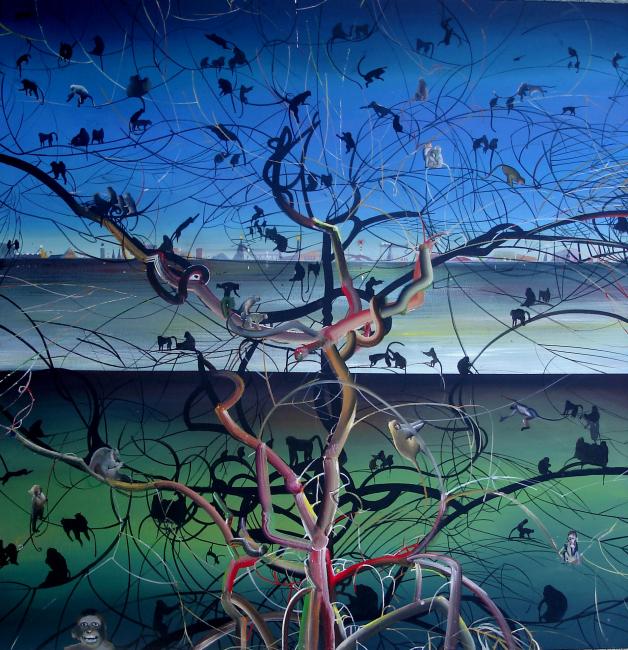
A painting of a large group of monkeys in a tree
2010
Space and Ladder, 2008, by Bhagyanath Chandroth
Space and Ladder, 2008
a drawing of a person laying down
Secret Dialogue 17
All works are copyright Bhagyanath Chandroth. Find out more at www.kashiartgallery.com/archives/bhagyanath
Even better, get in touch with him on Facebook, he’ll be happy to hear from you!

This Side of the Red Sticker

Maria Teicher is currently in the first year of her MFA at the New York Academy of Art.  Although painting is her first and foremost, Maria also works as a photographer.  With camera in hand at all the Academy’s events, her perspective is unique as it often changes within each new frame. A new conversation is heard with another focus of her lens.  
Originally posted by, Maria Teicher, MFA 2013

 
The general art loving/collecting public doesn’t often get to see the artist’s perspective behind the finished canvas. There’s often a lot more to the work hanging on the white wall before you. There’s a real human being there that is often overlooked and unrealized.


The Academy has some incredible opportunities for students attending. Deck The Walls is a big one. Three walls filled with incredible art by students and alumni are divided by price points while artists paint live models in the middle of our gallery space. Collectors and art lovers crowd around, finding art they connect to and some even purchase works to take home. This particular show is anonymous and the collector does not know who exactly they are purchasing work from until later.  It’s a beautiful idea that forces one to look at the work rather than the name of the artist. It’s a fun frenzy, but there’s more to it than one would realize.


I entered Deck The Walls with camera in hand (as usual) and walked around the room. The excitement from everyone was apparent and contagious. I stumbled over to where my pieces were and within the first hour, two had sold. Overjoyed, I immediately captured the red sold sticker and contacted my fiancé. It was an incredible moment but I wasn’t forced to analyze how big these moments can be until a little later on.


After walking around the event and documenting it’s blissful candids of holiday art, drinks and fun, (which you can see here: flickr) I found some of my fellow classmates and friends. A handful of us got wrapped up in great conversation as we quietly kept our eyes on our pieces. Some of us had sold works while others hopefully waited. I watched my classmate Daniela as the dialogue continued. She had yet to sell and I observed her  eyes floating back and forth from her piece to the conversation taking place. A few minutes passed and all of a sudden there was a red sticker placed next to her painting. The genuine excitement and emotion she exuded was beautiful, infectious and honest. Her eyes filled with quiet tears as she apologized for becoming emotional. She explained that this was her first work ever sold and the weight of the moment was felt by all. Standing there with her, the group of us couldn’t be more thrilled for her. It was only a few minutes in time, but that feeling will stay with me for years to come.  

 
photo of a painting of car on a gallery wall marked as sold

To put your mind, heart and hand into something (no matter the subject) takes a lot of courage. When someone you do not know connects enough with something you have made to purchase it, it is a feeling like no other. Art lovers and collectors may not realize that these little moments exist, but they do. They’re a silent encouragement to the artist. They are a confirmation that our passion, hard work and skill can make connections to the world we observe and choose to express through creating. 

 
There’s an entire world on the other side of the red sticker and although I’m slighting bias, I must say that it’s a really great one.
 

Escape from Studio Lockdown: Creating in the Multiverse

The best way to make a dramatic leap as an artist is to stop working. After Hilary Harkness‘ show at Mary Boone Gallery in 2011, she laid down her brushes for a full month and went to southern India. Personal transformation aside, she will never evaluate art the same way again.  Here are some ideas for ways to push your practice forward from the subcontinent.


Creating in the Multi-verse


The interior of an underground temple in MaharashtraImagine yourself scratching out a living in a harsh environment, circa 500 CE. Aesthetics are not a top priority for you, and you may have never seen a painting. You are hired as a laborer and for the very first time, you are brought into a temple…and it’s like a supernatural experience.

photo of a small valley carved into a rocky hillside 
In 1819, a British officer hunting tiger deep within the tangled undergrowth of Maharashtra discovered a series of twenty abandoned cave temples.

 
paintings on an underground temple wall depicting a large group of people
In the years 460 to 480 CE, the temples were simultaneously carved into the face of a cliff, most of which were monasteries and sanctuaries. Hundreds of artists seem to have been involved in the work, with possibly a fruitful rivalry between the neighboring construction sites. Many stone pillars within the temples are musical and resonate when tapped, and the acoustics have been engineered to extremely magnify the chanting of the innermost person. The surviving wall and ceiling paintings are intricate, colorful, and shocking in the sumptuous world they create.
a yellowed painting on an underground temple wall depicting a large group of people
So much of contemporary art exists to reflect, interrogate, or respond to culture. Outside a high-art context, a work of art might not have as much resonance. Art that is amusing when installed in one place becomes barren in another. 
painting on an underground temple wall depicting a large group of people
What can you make that is like a different universe of images and ideas?….
What system of organizing your ideas will yield the most intense experience for viewers – or even suck them into another, better universe?….
Who can you hire to make it?….
photo of a darkly lit underground temple

The Ones: Alumni Reunion Exhibition
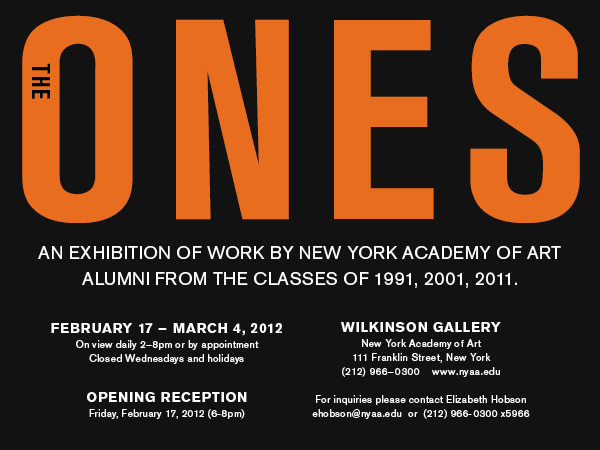
the_ones_evite

Escape from Studio Lockdown: Tom Cruise has good taste


The best way to make a dramatic leap as an artist is to stop working. After Hilary Harkness‘ show at Mary Boone Gallery in 2011, she laid down her brushes for a full month and went to southern India. Personal transformation aside, she will never evaluate art the same way again.  Here are some ideas for ways to push your practice forward from the subcontinent.
Tom Cruise has good taste!
photo of Jin Mao Tower
Jin Mao Tower
 
I’m a Skidmore, Ownings and Merrill junky!
This architecture firm has brought us the Time Warner Center in NYC, the Jin Mao Tower, and the lovely alabaster Beineke Rare Books & Manuscripts Library at Yale. 
photo of Burj Khalifa, Dubai
Burj Khalifa, Dubai
They also designed the current tallest building in the world, the heaven-piercing Burj Khalifa in Dubai. You know this building – Tom Cruise climbs it in Mission: Impossible. Sexy assassins cavort in its tight curving rooms reminiscent of mitochondria. The Burj Khalifa is all about the pressure between intricate, minute interior details and the infinity of the desert sky.


photo of Park Hotel, Hyderabad
Park Hotel, Hyderabad
 I recently made a pilgrimage to the S.O.&M 2010 creation, the Park Hotel in Hyderabad. This Indian metropolis is a hi-tech capitol known for its unbridled love of the clean, the modern and the futuristic. I was attracted to the hotel by its mix of soft-core sci-fi and Indian kitsch (I secretly wished to run into Captain Kirk lounging in Siek attire sipping a Klingon mocktail).  
photo of Carbon Bar, Park Hotel, Hyderabad
Carbon Bar, Park Hotel, Hyderabad
Unfortunately, the Park Hotel did not deliver.  Here’s why Tom Cruise passed on the Park Hotel:
Overworked and under-felt: Hyderabad is known as the jewel box of India as it was once the center of the pearl and diamond trade. The hotel’s façade references jewelry designs of the Nizam’s legendary jewellery collection (at the behest of the owner of the hotel). The jewelry box details are too fussy for the strong shapes of the architecture. Inside, elements (such a laser-carved golden coffee table) end up looking cold and untouchable. Decorative wallpapers are visual static – the busyness doesn’t add to the greater whole.
It’s a bad idea to build interior spaces from tableaux. The photos look great, but the interior spaces are clunky.  Two-dimensional tableaux should be products of great 3-D spaces, not the other way around. The photo-op should not be king.
photo of Interiors, Park Hotel, Hyderabad
Interiors, Park Hotel, Hyderabad
Two trites don’t make a right. This mash-up of the futuristic International style and historic jewelry bring out the weaknesses in both. The owner of the building should have backed off and let S.O.&M. do what they do best.
I recommend saving your money to visit the future tallest building in the world (soon to be built in Azerbaijan) – it will be 27% taller than the Burj Khalifa!

What is your favorite building, in NYC or otherwise? 
Any disappointments? 
Please feel free to chime in!

Faculty Spotlight: An Interview with Ted Schmidt

by Amanda Scuglia, MFA 2013


photo of two people standing together within a darkly painted art gallery

Where are you from originally?


I was born in Ann Arbor, Michigan, and lived there until I was 16. I spent some of my high school years at school in Switzerland. I came to New York in 1964.

Tell me a little about your own personal work..


I had several wonderful teachers who had significant influence on the evolution of my work. Though I had early training in abstraction from Gabriel Laderman (student of de Kooning and Han Hofmann) and Stanley Hayter (Surrealist and teacher of Pollock), I have been strongly figurative for the past 45 years). The several schools I attended in Europe: International School in Geneva, Ecole des Beaux-Arts in Paris, Atelier 17 in Paris, and The American Academy in Rome, allowed me to travel widely and to deeply absorb the classical tradition. My focus has always been the human figure. I prefer to work directly from life, sometimes from photos (as an aide-mémoire), and very often from memory and invention. 

Painting of 3 nude women by Edward Schmidt

You are one of the founders of the New York Academy of Art; Tell me how that came about:

I was the Academy’s first and only teacher when the school began in 1982. That year I was awarded the Prix de Rome, and after teaching for a semester, I left for the American Academy in Rome. I returned in 1984, and rejoined the New York Academy. We expanded the curriculum to include sculpture, anatomy and life-size painting. The reason I was included among those planning the birth of the Academy, was because in 1981, I had a solo museum show and the museum’s director was an important figure in the planning group. He brought me in. 


photo of Andy Warhol
Andy Warhol was another one of the founders, did you know him?

Andy Warhol was really devoted to the Academy in its early days. Surprisingly, his personal taste – the art he collected and chose to live with – was classical in nature. He actually drew well and considered training in drawing essential for an art student. After his unfortunate early death, his foundation directed its funds entirely to the Academy. For the next two years our students attended the Academy free, under Warhol Scholarships! This ended when Warhol Foundation politics caused a change in priorities. Anyway, Andy was close to our school in the beginning. I did spend an afternoon at the “Factory†and watched him at work. We went together to an opening, and later he visited me in my studio. I remember he said my work was ‘beautiful.â€

Dark painting of 2 women laying down
Since youve been here since the beginning, can you tell me how the Academy has changed over the years?
No doubt, the Academy right now has never been better. The early days were very tumultuous. However, our students have always been talented, and have often produced wonderful work. I think we are doing about as well as possible, with a wide range of devoted teachers and courses, and a philosophy that encourages a wide range of creativity.

What do your think makes NYAA’s MFA program different from others?

The NYAA is certainly unique as a graduate art school. Of course, we offer technique and skill-based courses focused on the human figure. Our community of amazing art students, who share so many interests, ideas and creative goals, very much contributes to this special place.

Have any favorite quotes?

My beloved teacher, Lennart Anderson, said to me “An artist has to keep his (or, her) life simple.â€

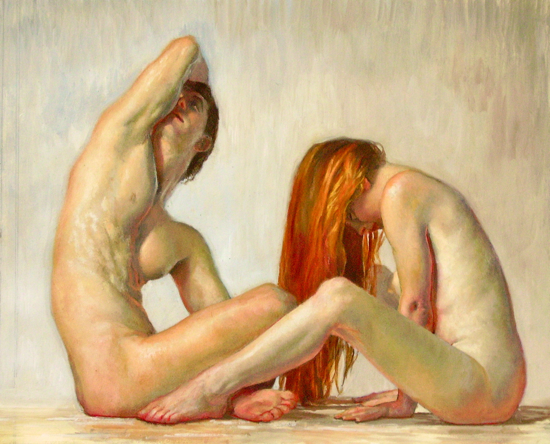
a painting of two women, one topless, sitting together

Escape from Studio Lockdown

The best way to make a dramatic leap as an artist is to stop working. After Hilary Harkness‘ show at Mary Boone Gallery in 2011, she laid down her brushes for a full month and went to southern India. Personal transformation aside, she will never evaluate art the same way again.  Here are some ideas for ways to push your practice forward from the subcontinent.
WHO CAN PAINT?
a red truck covered with small paintingsJingle truckers, that’s who. Mumbai is swarming with hand-painted vehicles! From three-wheeled tuk-tuks to commercial trucks no opportunity for adornment is lost. The paint-jobs are so elegant that most look like they were done by professionals specializing in custom work.
Surprisingly, each one is painted by its owner, so naturally many of the designs contain personal religious significance.  Nothing is over-worked, each one is unique, and there is no sign that any driver suffered from a lack of ideas.
What can you make effortlessly that is meaningful to you, without being half-assed or obscure?
a large truck hand painted with various imagery in Mumbai
a large red truck with many small paintings and decorative accents


a red semi truck with hand painted lettering across the frontA large green truck covered in hand painted script
The back of a white truck covered in painted words 
Did you miss Hilary’s 2011 posts “Notes from Studio Lockdown?  Read what she had to say in the fall of 2010 while she prepared for her 2011 show at Mary Boone Gallery in New York City.