Studio Agreement Terms and Conditions
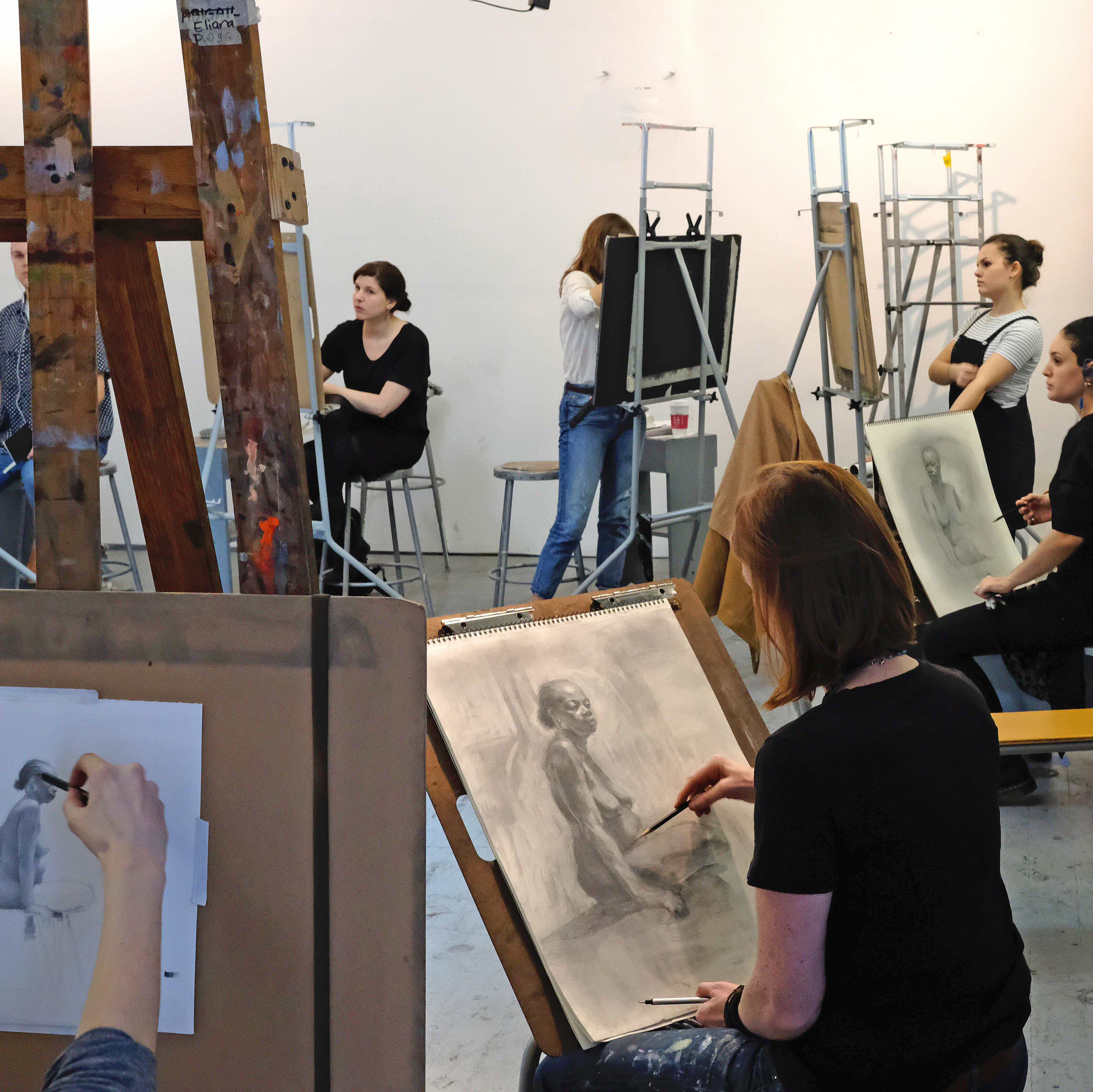
The Academy provides on-premise studios for full-time MFA students during their course of study and full-time CFA students during their summer term. Studios are grouped to create an exchange of ideas and thinking across disciplines. Faculty members make regular tours of the studio spaces for tutorials and formal critiques.
Everyone is responsible for maintaining a safe and healthy studio environment. Your conduct in the studio — and especially in the classroom — affects not only your own health, but also the health of everyone else in the building. As part of your studio-art training, students are expected to review the proper use and disposal of materials, including all relevant safety procedures. If you are aware of a health or safety issue, or are unsure of a process or material, please seek immediate guidance from Operations Manager Tim Buckley (tbuckley@nyaa.edu).
General Guidelines
Walls, floors, and classroom equipment must be kept clean and free of debris.
- If your work spreads dust, debris, clay, plaster, paint, or other matter to these surfaces, use an appropriate protective covering — e.g. drop cloths, plastic sheeting, or paper.
- It is your responsibility to protect and clean up your work area. Studio Etiquette is your personal responsibility.
- Sanding is only allowed on the Garden Level with the use of HEPA equipment — Particulate filters, downdraft tables, and vacuums. Questions? Ask the Studio Manager.
- Dust should never be swept. Use a HEPA vacuum or mop to clean up dust.
Students may not alter existing classroom structures or mechanical systems.
- Do not hang anything from or otherwise interfere with the fire-suppression system — the green and red pipes, sprinklers, strobe lights, alarms, or sensors.
- Do not hang anything from or otherwise interfere with ductwork, air handlers, or any component of the HVAC system.
- Do not touch the radiators.
Sinks and surrounding areas must remain clean and clear.
- Paint waste, whether aqueous or oil/solvent-based, should never be poured into the sink. This waste should be discarded using the provided RED liquid waste containers located on each floor.
- No clay or plaster is allowed in the sink area.
- Rooms must be left organized and clean of any debris or trash. On the 5th Floor students are to place easels, drawing horses, tabourets, and/or stools along the window wall. 2 heaters, for use by the models, must remain in the classrooms at all times. UNPLUG all heaters after use. All fabric, cushions, or foam must be returned to the prop closet after every class.
Sculpture Studios
- Buckets, tools, or hands that are covered in clay or plaster should never be rinsed off in the sink – doing so will clog the drain. Use a wash bucket for initial cleanup. Studio Etiquette is your personal responsibility.
- Clay, plaster, and marble are the most common materials in the sculpture studios. The dust from these materials contains silica and is hazardous—To prevent silica from becoming airborne, clay should be kept moist, and the HEPA equipment must be used when handling plaster and stone.
- Classrooms Gl1, Gl2, and workspace GL3 all have HEPA air filtration units and downdraft tables for sanding or other processes that may create dust.
- Clay must be kept moist at all times. Any clay scraps must be placed in a bucket. It is your responsibility to mop the floor in your work area and clean studio surfaces with a wet sponge after use. Studio Etiquette is your personal responsibility.
- Sweeping, dusting, and vacuuming (unless HEPA) should never be done in the sculpting classrooms. These cleaning methods will fill the air with dust. Please use a mop, sponge, or one of the BLUE HEPA Vacuums.
- Clay sculptures that must be dried before entering the kiln should be placed on designated shelving.
- Kiln use can be scheduled by writing your name on the kiln room door calendar. Questions? Contact the Studio Manager.
Painting Studios
- No turpentine or turpentine based mediums/varnishes. If you are unsure…ask first.
- Store solvent, oil, and mediums in the storage cabinet located on your studio floor. Follow the posted HAZCOM procedures. Label everything with your full name and year. If the solvent, oil, or medium is not in its original container please also label the jar with its contents.
- Avoid leaving jars of solvent open. Put a lid on it. Studio Etiquette is your personal responsibility.
- DO NOT KEEP PAINT/OIL/SOLVENT SOAKED RAGS OR PAPER TOWELS IN YOUR STUDIO. Dispose of paint rags in the designated bins located on each floor.
Storing artwork and personal belongings
- When class ends, paintings are to be taken back to your studio or stored in the racks and sculptures are to be placed on shelves. Do not leave sculptures on sculpting stands. Classrooms cannot be cleaned properly if the floor can’t be cleared.
- All stored materials must be labeled with your full name and year.
- Nothing can be kept in the hallway. Hallways must remain unobstructed.
____________________
Model Coordinator general info:
The model coordinator is available from 9:30-5 pm Monday – Friday, in their office on the 5th floor. For evening and weekend classes, the model contact sheet may be accessed at the front desk.
Arielle Tesoriero – Studio Manager and Model Coordinator – atesoriero@nyaa.edu
How Students can book models:
Students may book models for their own personal projects but they are responsible for all arrangements and payments. The model coordinator may provide the contact information for models only. Room requests can be booked through the Registrar at https://nyaa.edu/classroom-reservations/.
Faculty Model Requests:
Each semester, Faculty must complete a model request form by a date which is determined by the Model Coordinator. Requests are processed in the order which they are received. We recommend faculty choose 5 or more models as their preference for their classes from our Model PowerPoint, which is a document that records the headshots and availability of models. Faculty may not arrange bookings with models or hire them. All bookings and model hires must be arranged and confirmed by the Model Coordinator. To recieve a model request form, please email Arielle Tesoriero at model@nyaa.edu.
Photography of Models for Faculty:
Models must sign a photo release form, which can be obtained by the Model Coordinator, before each photo session – clothed, or nude. The Model and Model Coordinator, must sign this document before photos are taken. To recieve a model photo relase form, please email Arielle Tesoriero at model@nyaa.edu.
Model Etiquette Overview:
- No phones while the model is posing. If there is need to use a phone, excuse yourself quietly, or wait for the 5 minute break between poses.
- Students are expected to respect the “model posing” / “model not posing signs,” posted outside every classroom door. If the model is posing and students need to re-enter the classroom, they must wait for the pose to finish. Students may knock on the door to let their presence be known to the instructor. TA’s are responsible for changing the signs after every break.
- Absolutely no photos of the models, nude or clothed. Photos require a completed Release Form.
- Students may not touch the model or walk near the model stand while the model is posing.
- Only the Instructors and TAs may speak to the model when they are posing. If the pose needs to be adjusted, students may let the professor know.
- Our models are trained professionals, however, if a model exhibits behavior that makes you uncomfortable, we advise that you let the instructor know immediately.
These policies will be reiterated during student orientation, the first week of school.
For more information about models, or access to the prop closet, please contact Arielle Tesoriero, the Model Coordinator, at Model@nyaa.edu
Materials
Storage of Materials
- All hazardous materials must be stored in containers that are clearly labeled with contents.
- Containers should be tightly covered when not in use.
- Flammable liquids must be stored in an approved flammable liquid storage cabinet.
- Acids must be stored separate from flammable and combustible liquids.
- Safety Data Sheets for all chemicals currently stored, can be found HERE.
Handling, Use, and Disposal of Materials
- All students must be given detailed instructions on the handling, use, and disposal of materials that pose potential health hazards.
- Paper towels and rags used in cleanup must be disposed of in the RED, metal, non-combustible waste disposal cans.
- Waste disposal cans are located on every floor and are labeled as such – Liquid or Solid waste.
- Report spills immediately to faculty, studio managers, administration, or security.
Hazard Communication
The goal of Hazard Communication is to protect people from injuries and illnesses associated with using hazardous chemicals in the workplace. People have the right-to-know and understand the hazards and identities of the chemicals they are exposed to at work.
- HAZCOM
- Where to find, and the information contained in, Safety Data Sheets (SDS).
- Protocol for container labels. Everyone must follow these rules when storing containers at the Academy. HAZCOM protocol is posted on every storage cabinet.
- Safety Data Sheets
- Link above to SDS for all chemicals currently stored.
- SDS can often be found on the manufacturer’s website or by simply googling the name/tradename of the substance followed by SDS.
More information on Hazard Communication and standards for Personal Protective Equipment can be found on the OSHA website. Links below.